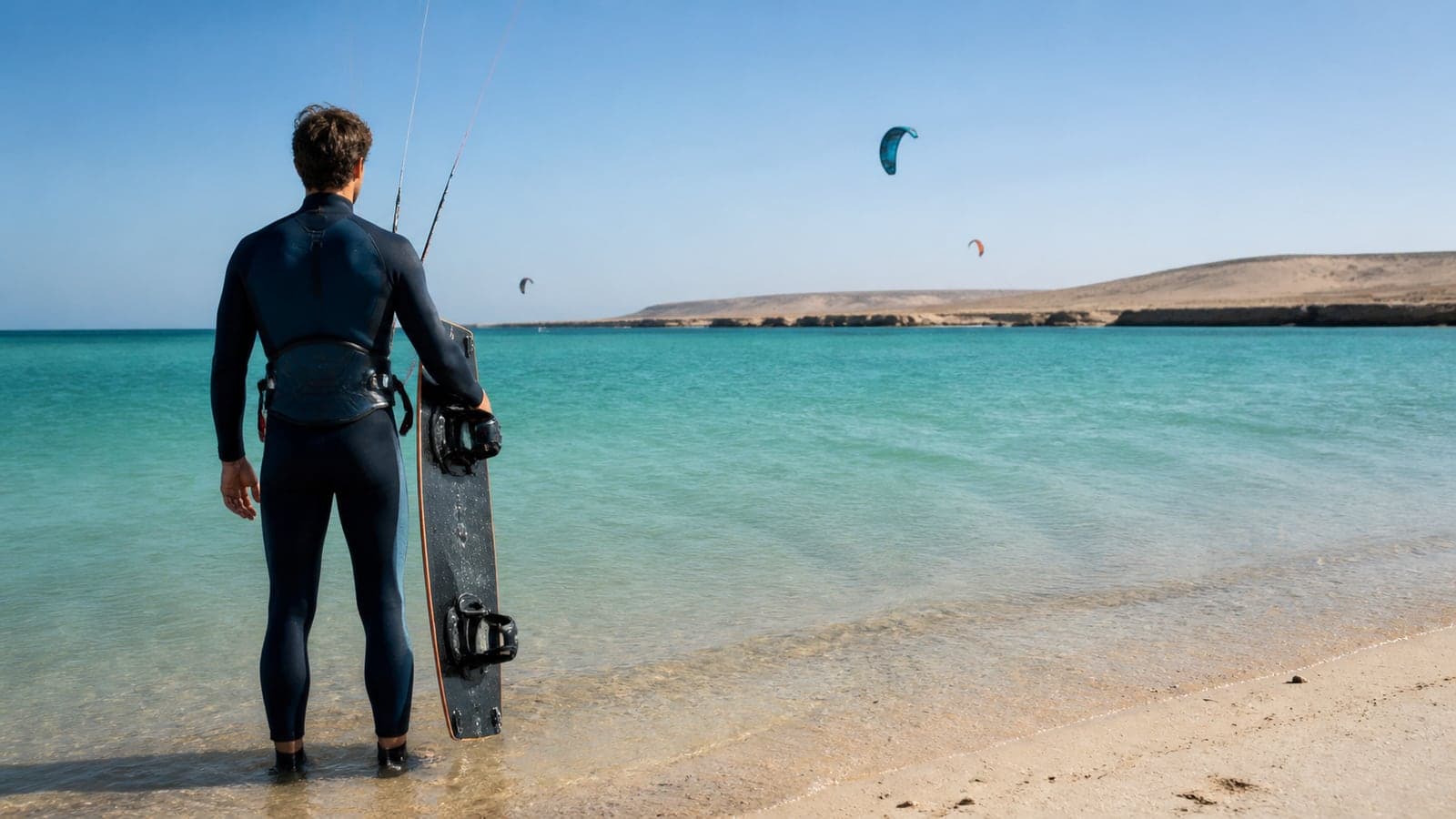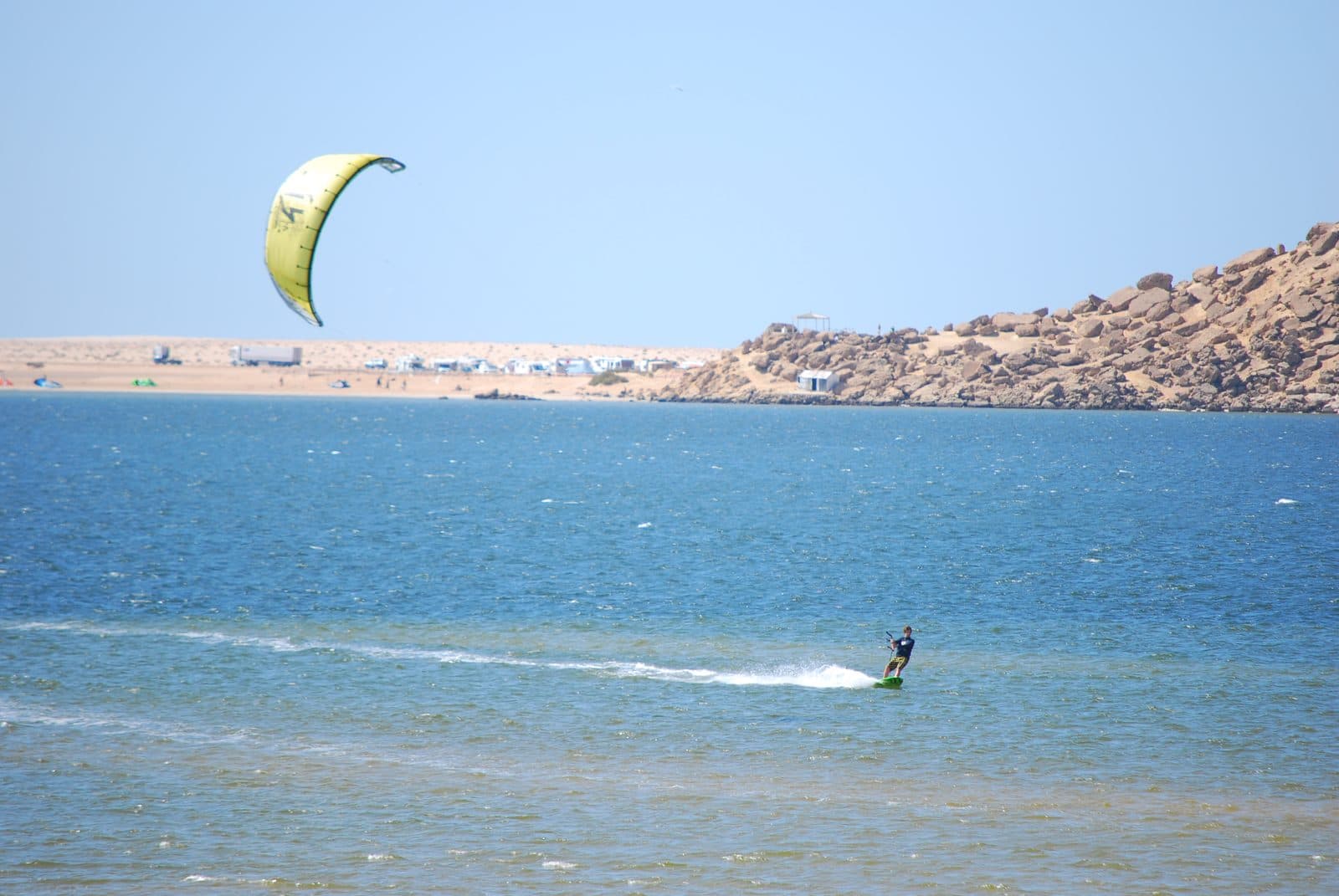
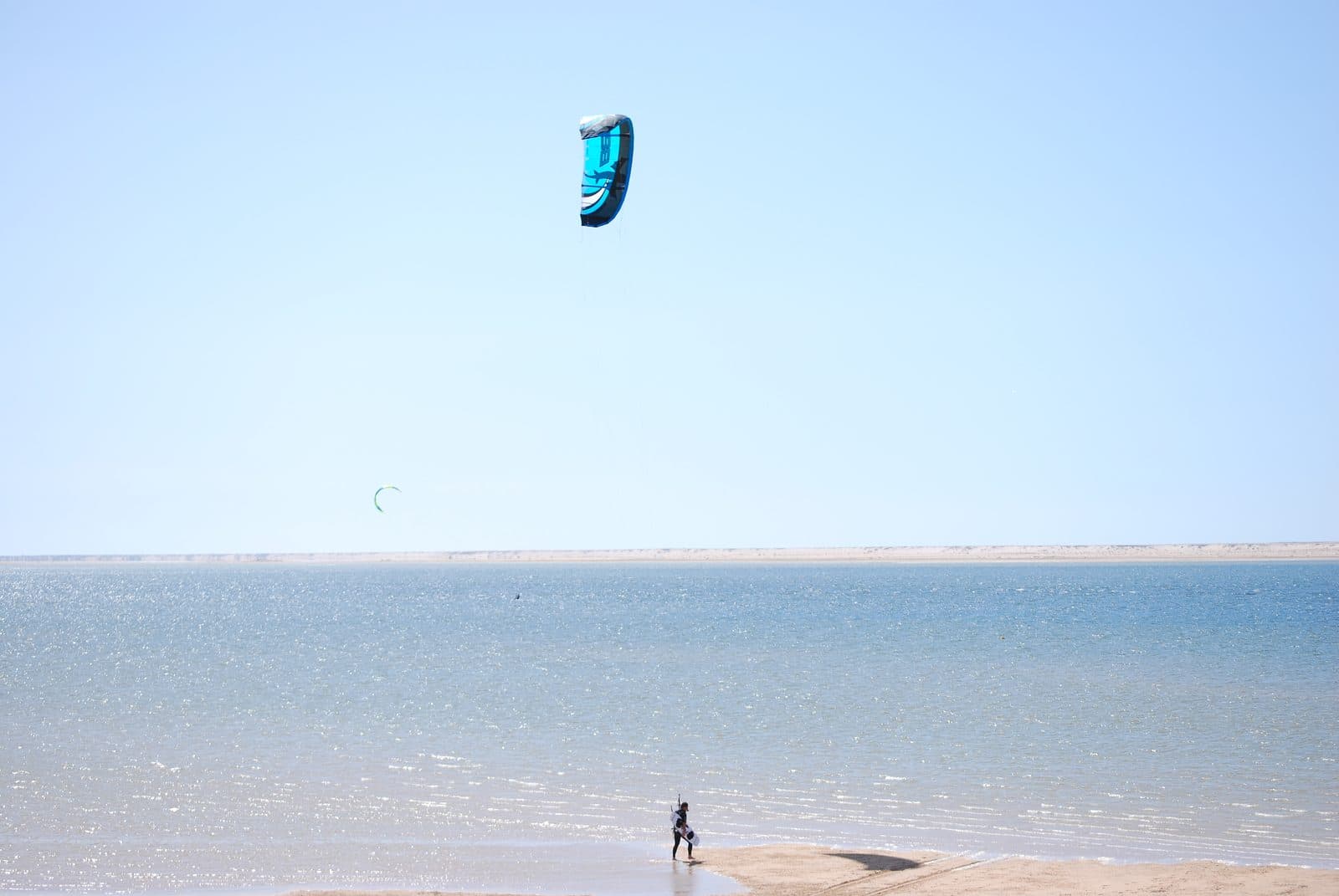
Dakhla is one of the few places on earth where a complete beginner can realistically go from never having flown a kite to riding independently inside a single week. That is not marketing: it is a direct consequence of the geography. A 40 km lagoon of shallow, standing-depth water, a trade wind that arrives on the great majority of afternoons, and almost no rain to interrupt a course.
Why the lagoon works so well for learning
Three things make the difference between a good learning spot and a frustrating one, and Dakhla Lagoon has all three.
- Standing depth. Across large areas of the lagoon you can put your feet down. When a beginner can stand up, reset the kite and start again without swimming, the learning curve gets dramatically shorter.
- Side-onshore wind. The dominant north-east trade blows across the lagoon toward the shore at an angle. If something goes wrong, wind and water push you back toward land instead of out to sea.
- Consistency. Between April and September the wind blows on most afternoons, typically 18 to 28 knots. You are not gambling a week of holiday on two windy days.
The water is not always mirror-flat — an afternoon of 25 knots builds a short chop — but compared with an ocean beach and its shore break, the lagoon is forgiving.
When to come as a beginner
Peak wind season (June to August) is not automatically the best beginner season. Very strong wind means smaller kites, faster reactions and more time spent waiting for a lull. Two windows suit first-timers better:
- March to May — reliable wind that is strong without being brutal, and camps are not yet at their fullest.
- September to October — the warmest water of the year (around 21 °C), still-good wind and thinner crowds after the European school holidays.
Winter (December to February) has lighter, less reliable wind, but it is the cheapest period and lessons still run. Expect a 4/3 mm wetsuit and a few days where the wind simply does not arrive.
What a realistic first week looks like
Book at least five days of lessons, and ideally seven days of trip so you have spare days. A typical progression:
| Day | What you work on |
|---|---|
| 1 | Safety systems, kite setup, flying a trainer or small kite on land, self-rescue theory. |
| 2 | Kite control in the water, body dragging downwind, recovering the kite from the water. |
| 3 | Upwind body drag with the board, water starts, first short rides. |
| 4–5 | Riding longer distances, staying upwind, controlled stops and turns. |
| 6–7 | First independent sessions with supervision, basic transitions. |
Progress is not linear. Some people water start on day three, others on day six. Previous board-sport experience (snowboarding, wakeboarding, surfing) helps, but kite control matters more than board skill, and that is a coordination skill that simply needs hours.
How to choose a school
Dakhla has dozens of camps and schools of very different quality. The price difference between a weak school and a strong one is usually small; the difference in what you learn is not. Ask about:
- Group size. One instructor for one or two students. Three or more students per kite means you spend most of the lesson watching.
- Radio helmets. Being coached while you are 50 m away in the water is worth more than any other piece of equipment.
- Rescue cover. A boat or jet ski on the water during lessons, not just parked on the beach.
- Equipment matched to your weight. A 55 kg student and a 95 kg student cannot learn on the same kite.
- The east-wind question. Ask directly: "What do you do when the wind turns easterly?" A good school will tell you it moves or cancels lessons, because east wind on the lagoon is offshore. A school that shrugs is a school to avoid.
- Certification. IKO or VDWS credentials are not a guarantee of quality, but they do mean the instructor has been trained to a syllabus.
The daily rhythm you should plan around
The wind in Dakhla is thermally reinforced: the Sahara heats up during the day, hot air rises, and cool ocean air rushes in to replace it. In practice this means mornings are light and afternoons are windy. Most schools schedule theory and land work in the morning, and water time from late morning onward. Eat and hydrate before the wind peaks — a first-week student burns far more energy than they expect.
What to bring
- Wetsuit: 3/2 mm for most of the year, 4/3 mm from December to April. Camps rent them, but a suit that fits is worth carrying.
- Sun protection: SPF 50, ideally reef-safe, plus a long-sleeve lycra. The UV index in Dakhla reaches 9–11 for much of the year and the constant wind hides the burn until it is done.
- Sunglasses with a leash for shore time, and a buff for blowing sand.
- Impact vest and helmet — shallow water is exactly what injures beginners, and most schools require both anyway.
- A windproof jacket for evenings: nights drop to 14–20 °C depending on the season, and the breeze makes it feel cooler.
Mistakes that cost beginners a week
- Booking too few days. Three days of lessons rarely produces an independent rider, and it leaves no margin for a light-wind day.
- Renting equipment too early. Riding unsupervised before you can stay upwind means long walks and, on the wrong day, a genuine rescue.
- Ignoring the sun. A serious burn on day two ruins the rest of the week more effectively than any wind forecast.
- Choosing a camp by photos alone. Look at where it sits on the lagoon, how far it is from town, and whether it has its own rescue cover.
After the first week
Independent riding is the beginning, not the end. Before you ride alone anywhere in Dakhla, you should be able to stay upwind, stop where you intend to, and perform a full self-rescue with the kite in the water. Once you can do those three things, the lagoon opens up — and the spot pages on this site will help you match the day's wind direction to the right launch.